How can you best approach a customer with a VodaPay device? Which iKhokha device can you sell to them? Here we give you an in-depth look at the VodaPay devices and how you can make the sale by switching a customer to an iKhokha device.
The VodaPay device specifications
It pays to know your competition – familiarise yourself with the VodaPay devices here.
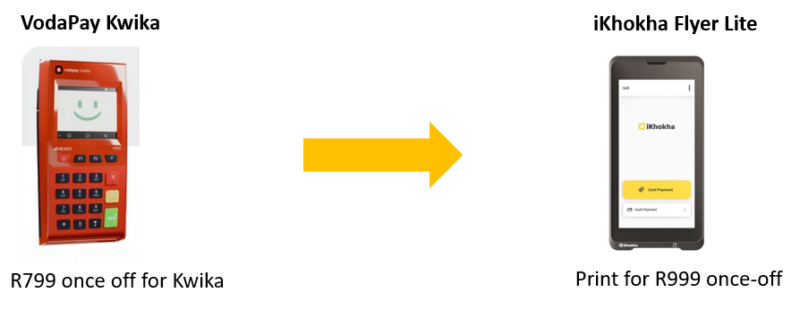
The VodaPay Kwika
R799
Accepts local and international card payments
Standalone device
Can not print receipts
Built-in dual sim cards
Additional income stream – VAS functionality
Links to any bank account of your choice
The VodaPay Max
R311 monthly rental
Accepts local and international card payments
Standalone device
Can print receipts
Dual sim and Wifi connection
Additional income stream – VAS functionality
Links to any bank account of your choice
Which iKhokha device would you offer a VodaPay customer?
Now that you are familiar with the VodaPay devices, we can show you which iKhokha device would be the best to pitch to the customer, and why:
The selling point:
VodaPay Kwika R799 – iK Flyer Life R999 (R200 more, but you can print on the iK Flyer Lite).
VodaPay Max R3732 (R311 rental x 12 months) – iK Flyer R1499 = a saving of R2233 in the first year.
iKhokha settles daily from Monday to Saturday at R2,50 (if you settle). They don’t settle on Sundays or public holidays. Should a customer settle six days a week, four weeks per month, they’ll spend max R60.
VodaPay does not charge settlement fees.
Summary
We’ve summarised the key points for customers who either own or rent VodaPay devices.
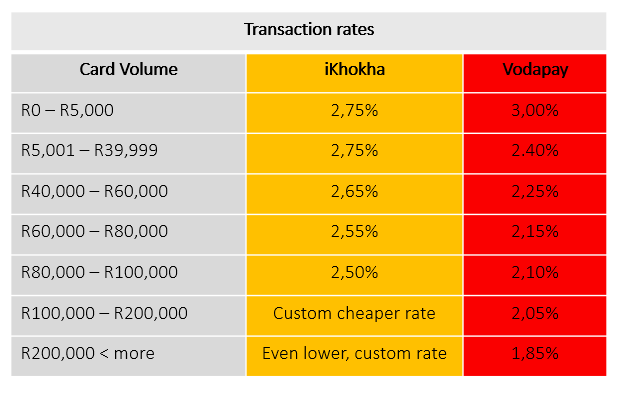
The iKhokha device offers more value for money—you own the device upon purchase, which gives you an immediate saving that outweighs the lower transaction rates (depending on volume).
If you are a small business accepting less than R5000 in card payments per month, you will save on both device purchases and transaction rates.
If your card transactions are over R100 000 per month, iKhokha could offer you better transaction rates, and you can save on device purchases.
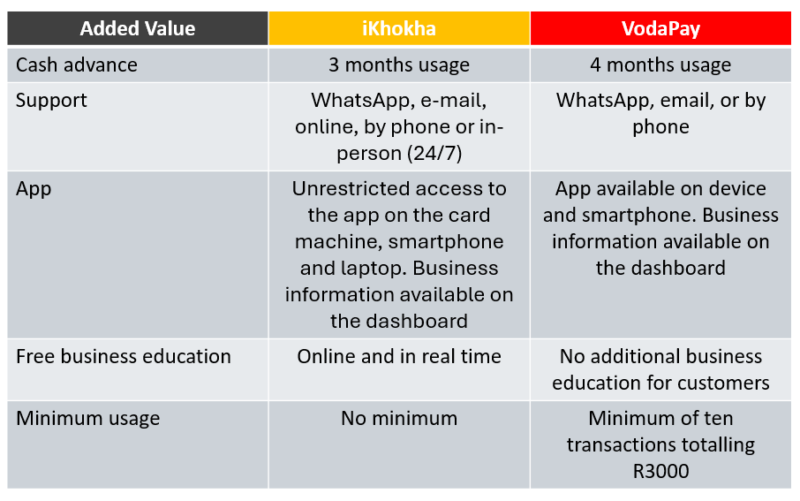
iKhokha customers have access to a cash advance a full month before VodaPay customers.
VodaPay doesn’t charge settlement fees.
The VodaPay Max device comes with a list of minimum usage criteria customers should be aware of.
Test yourself
Which iKhokha device would you recommend to a VodaPay Kwika customer?
How much will VodaPay Max customers save in terms of rental costs over the first 12 months if they move over to iKhokha Flyer?
Does VodaPay charge settlement fees?
Can you list the minimum usage requirements for VodaPay Max users?
Which VodaPay device do you rent, and which one can you purchase?
The VodaPay transaction rates are lower (generally between R5001 – R100 000), list the additional selling points you could communicate to convince the customer that an iKhokha device is a better option.